Meet My Friend

He is the Best Friend you will ever have!

  • Home
  • About Me
  • Experiences
    • Breathe Easy
    • Heavenly Haircut
    • Life is a Gift
    • Trials
    • Wilderness Wandering
  • My Story
    • In The Beginning
  • Blog

Today is Ash Wednesday

February 10, 2016 by macornell

ash


In preparation for Easter, you may be wondering what is Lent? Dayspring has a helpful article that will help you understand what Lent means. Go here to read it. Consider these as your choice for something to give up for Lent…

40 Things to Give up for Lent
1. Fear of Failure
2. Your Comfort Zone
3. Feelings of Unworthiness
4. Impatience
5. Retirement
6. People Pleasing
7. Comparison
8. Blame
9. Guilt
10. Overcommitment
11. Lack of Counsel
12. Impunity
13. Entitlement
14. Apathy
15. Hatred
16. Negativity
17. The Spirit of Poverty
18. Going through the motions
19. Complaint
20. The pursuit of Happiness
21. Bitterness
22. Distraction
23. Giving up
24. Mediocrity
25. Destructive Speech
26. Busyness
27. Loneliness
28. Disunity
29. the Quick Fix
30. Worry
31. Idolizing
32. Resistance to Change
33. Pride
34. A Small View of God
35. Envy
36. Ungratefulness
37. Selfish Ambition
38. Self-Sufficiency
39. Sorrow
40. My Life


Want a Lent Devotional to start your day? Try this one!

 

lent


Share this:

  • Click to share on Facebook (Opens in new window) Facebook
  • Click to share on X (Opens in new window) X
  • Click to share on Pinterest (Opens in new window) Pinterest
  • Click to share on LinkedIn (Opens in new window) LinkedIn
  • Click to share on Reddit (Opens in new window) Reddit
  • Click to share on Tumblr (Opens in new window) Tumblr
  • Click to share on Pocket (Opens in new window) Pocket
  • Click to email a link to a friend (Opens in new window) Email
  • Click to print (Opens in new window) Print

Like this:

Like Loading...

Life is a Gift!

January 26, 2016 by macornell

I wrote the following message for my church and I hope it blesses you to read it…

All life is a gift – no matter what circumstances are good or bad. We can accept that we are fearfully and wonderfully made, Psalm 139:14 or curse the day we were born, Job 3:1. I have felt both pulling at me. Your thoughts are what determines how your day is going to go. I believe God is good and somehow He has worked everything out for my good, Romans 8:28. I don’t understand why I have to be completely paralyzed and have constant never-ending infections.  I don’t understand why I have to be here. I am tired of suffering and I know there is a procedure that will end my life. The problem with that is, this isn’t my life to end. God gives us life and He is the One who has the right to end it, Deuteronomy 32:39.  That truth is what stops me from going through with ending my suffering. I can’t imagine standing before Jesus and Him saying, ” Wasn’t I enough?” I don’t want to finish my journey like that. I have to keep persevering onward to be  blessed with crown of life,  James 1:12. I want to lay that crown at Jesus’ feet. The key to perseverance is believing the promises that the Lord has made. The world doesn’t have any promises or know we are dearly loved by our Creator so life is disposable to people.

I wake up every day and give the day back to the Father in heaven. He already knows how it is going to go and if I want to be blessed I have to expect Him to guide me through it. You don’t know how your interactions with people will produce fruit. I have days where I am not fruit minded but survival minded. As I look back I can see that the survival days were pretty much a waste of time. We are here to love, honor, glorify and obey the Lord who gives us everything we need. Just ask!

I know that God the Father’s goal for my life and everyone else’s is to make us like Jesus His Son. You don’t learn anything when the sun is shining and all is right. Learning lessons that will last for all eternity comes from pain, trials and hardship. It is not something I like but as I take stock of where I used to be and where I am now, I can honestly say thank You for allowing this pain to the Lord. ALS has brought me many tears of sorrow but the blessings outshine the grief. Lamentations 3:31-33 is where you can see that the Lord doesn’t like to bring affliction, but it is necessary for our good.

Share this:

  • Click to share on Facebook (Opens in new window) Facebook
  • Click to share on X (Opens in new window) X
  • Click to share on Pinterest (Opens in new window) Pinterest
  • Click to share on LinkedIn (Opens in new window) LinkedIn
  • Click to share on Reddit (Opens in new window) Reddit
  • Click to share on Tumblr (Opens in new window) Tumblr
  • Click to share on Pocket (Opens in new window) Pocket
  • Click to email a link to a friend (Opens in new window) Email
  • Click to print (Opens in new window) Print

Like this:

Like Loading...

Monday Musing

July 6, 2015 by macornell

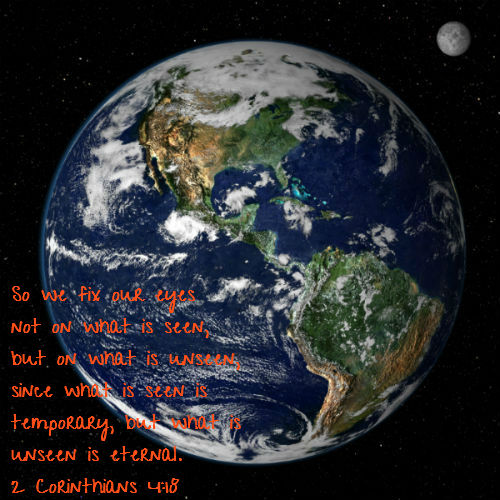
2_Cor_4_18

Living Above Your Circumstances

I was thinking about how to live above my circumstances. I know about Paul having learned how to be content in whatever circumstances he found himself in (Philippians 4:11). I am not there yet. I have 1 Thessalonians 5:18 “give thanks in all circumstances; for this is God’s will for you in Christ Jesus” on my wall, I see it every day. I am there sometimes. How can I give thanks for all my afflictions when they are causing me pain, fatigue and weariness?

I asked the Lord that question and this verse came to me: 2 Corinthians 4:18 “So we fix our eyes not on what is seen, but on what is unseen, since what is seen is temporary, but what is unseen is eternal”. Ok Lord I got it, keep my eyes on You! Peter walked on water towards Jesus. When he started noticing the wind, he got fearful (circumstances) and he started going down (Matthew 14:28-30). How many times have I done exactly that very thing and gotten discouraged? Too many times to count!

So, how do you live above your circumstances?

First, thank the Lord for what He has allowed. In doing this you are acknowledging His Sovereign control.

Everything that you go through is a growth opportunity. It is up to you what you do with it. It is easy to choose to be bitter and resent your trial or you can choose to embrace your chance to grow. Ask the Lord what He desires that you learn. Remember what Lamentations 3:32-33 says “Though he brings grief, he will show compassion, so great is his unfailing love. For he does not willingly bring affliction or grief to anyone.” The Lord will show you what He wants you to work on. Trust He has your good in His plan because He does (Romans 8:28)! Grow in your understanding that the Lord loves you too much to leave you a baby in your faith. Grow in trusting Him, He won’t leave you alone to face your difficult circumstances. I can testify to all these things. Finally, keep your eyes, heart and mind on what is unseen…Jesus.

Share this:

  • Click to share on Facebook (Opens in new window) Facebook
  • Click to share on X (Opens in new window) X
  • Click to share on Pinterest (Opens in new window) Pinterest
  • Click to share on LinkedIn (Opens in new window) LinkedIn
  • Click to share on Reddit (Opens in new window) Reddit
  • Click to share on Tumblr (Opens in new window) Tumblr
  • Click to share on Pocket (Opens in new window) Pocket
  • Click to email a link to a friend (Opens in new window) Email
  • Click to print (Opens in new window) Print

Like this:

Like Loading...

Looking for Today’s Daily Devotionals?

June 14, 2015 by macornell

I decided yesterday after receiving notice I had pinned something copyrighted on Pinterest, that I wasn’t going to do any posting unless it is from me!

Don’t fret if you enjoy these devotionals! There are easy ways to see them all. Biblegateway.com offers NIV 365-Day Devotional, John Piper, God’s Story for My Life and many other devotionals to your inbox every morning! Streams in the Desert can also be delivered to your inbox or you can simply bookmark the page and put it in your bookmark toolbar!

If you are on Facebook, I am still posting links to these devotionals! Enjoy your time with the Lord!

Share this:

  • Click to share on Facebook (Opens in new window) Facebook
  • Click to share on X (Opens in new window) X
  • Click to share on Pinterest (Opens in new window) Pinterest
  • Click to share on LinkedIn (Opens in new window) LinkedIn
  • Click to share on Reddit (Opens in new window) Reddit
  • Click to share on Tumblr (Opens in new window) Tumblr
  • Click to share on Pocket (Opens in new window) Pocket
  • Click to email a link to a friend (Opens in new window) Email
  • Click to print (Opens in new window) Print

Like this:

Like Loading...

Today’s 6/12/2015 Daily Devotionals

June 12, 2015 by macornell

365 devotional

The Game of Recovery (Proverbs 3:6)

The game of bridge has unusual terms exclusive to it. A round takes two games (legs) to win. A successful low bid adds a leg on the score sheet, a partial game. If the opponent wins a game before you complete your second leg, a line is drawn on the score sheet, and the partial game is forfeited. That’s called “cutting off your leg.”

Beginning bridge player Glenna often heard the strange expression, “We cut off your leg.” When she kept score and drew the line below a completed game, she saw a part score forfeited.

“Now I get it. It just clicked.”

Divorce recovery is like bridge. Expressions repeatedly heard in recovery books and classes finally click. “This too shall pass.” “Seek supportive friends.” “Live better, not bitter.”

These and other good expressions, tools of truth, are often repeated. Coping statements help us out of despair into a better life. There has been too much loss and pain—too much to face. The need to quit feeling awful is strong, so we grab tools because life was hard, then it got harder.

Christian living for singles has a similar pattern. Planting simple truths in our minds trains us to become comfortable with who we are. “Give thanks for all things.” “Jesus loves and comforts.” “Fear not, I am with you.”

With a new life of recovery from divorce, Christian living emerges and hope takes root. We go from victim to victorious acceptance.

In the game of life, as in the game of bridge, we need two legs—ours and God’s—to complete the game and win. As we join with Jesus and become one body, we win. Click. No opponent can ever cut off our leg again.

Anita Brock

Taken from Fulfilled


johnpiper

Faith for the Future

For all the promises of God find their Yes in him. (2 Corinthians 1:20)

If “all the promises of God find their Yes in [Jesus],” then to trust him now in the present is to believe that his promises will come true.

Those are not two separate faiths — trusting him, and believing in his promises. Believing in Jesus means believing that he keeps his word. Being satisfied in the crucified and risen Jesus now includes the belief that at every future moment, to all eternity, nothing will separate us from his love, or keep him from working all things together for good.

Putting it all together, I would say that the spiritual beauty we need to embrace is the beauty of God that will be there for us in the future, certified for us by the glorious grace of the past.

We need to taste now the spiritual beauty of God in all his past achievements — especially the death and resurrection of Christ for our sins — and in all his promises. Our confidence and trust must be in all that God himself will be for us in the next moment, and in the next month, and in the endless ages of eternity — “the light of the knowledge of the glory of God in the face of Jesus Christ” (2 Corinthians 4:6).

It is he and he alone who will satisfy the soul in the future. And it is the future that has to be secured and satisfied with spiritual riches of glory, if we are to live the radical Christian lives that Christ calls us to live here and now.

If our present enjoyment of Christ now — our present faith — does not have in it the Yes to all God’s promises, it will not embrace the power for radical service in the strength that God (in every future moment) will supply (1 Peter 4:11).

My prayer is that reflecting like this on the essence of faith will help us avoid superficial, oversimplified statements about believing the promises of God. It is a deep and wonderful thing.


Gods story

Job 40:3-24

Job is given a chance to respond to God, but he realizes his lack of understanding. God responds to Job’s epiphany.

Human Limitations

Read

Then Job replied to the Lord, “I am nothing—how could I ever find the answers? I will cover my mouth with my hand. I have said too much already. I have nothing more to say.”

Then the Lord answered Job from the whirlwind: “Brace yourself like a man, because I have some questions for you, and you must answer them.

“Will you discredit my justice and condemn me just to prove you are right? Are you as strong as God? Can you thunder with a voice like his? All right, put on your glory and splendor, your honor and majesty. Give vent to your anger. Let it overflow against the proud. Humiliate the proud with a glance; walk on the wicked where they stand. Bury them in the dust. Imprison them in the world of the dead. Then even I would praise you, for your own strength would save you.”
(Job 40:3-14)

Reflect

The book of Job presents four views of suffering. Satan’s view is that people believe in God only when they are prospering and not suffering. Job’s three friends—Eliphaz, Bildad, and Zophar—believe that suffering is God’s judgment for sin. This may be true at times, but not always. Elihu’s view is that suffering is God’s way to teach, discipline, and refine. This is true, but it is an incomplete explanation. God’s view is that suffering can cause us to trust him for who he is, not what he does.

Throughout his time of suffering, Job longed to have an opportunity to plead his innocence before God. Here God appeared to Job and gave him that opportunity. But Job decided to remain quiet because he no longer had the need to speak. God had shown Job that, as a limited human being, he had neither the ability to judge the God who created the universe nor the right to ask for God’s reasons.

God’s actions do not depend on ours. He will do what he knows is best, regardless of what we think is fair. Nonetheless, God came to Job and showed Job his love and care.

Respond

Does your view of suffering match what the book of Job reveals about God and his view? If not, what objections do you still have? If so, how can you trust God more, not only in the hardships but also in the easy times?


4628-StreamsInDesert_2011Header.600w.tn.jpg

Streams in the Desert – June 12

In everything ye are enriched by him (1 Cor. 1:5).

Have you ever seen men and women whom some disaster drove to a great act of prayer, and by and by the disaster was forgotten, but the sweetness of religion remained and warmed their souls?

So have I seen a storm in later spring; and all was black, save where the lightning tore the cloud with thundering rent.

The winds blew and the rains fell, as though heaven had opened its windows. What a devastation there was! Not a spider’s web that was out of doors escaped the storm, which tore up even the strong-branched oak.

But ere long the lightning had gone by, the thunder was spent and silent, the rain was over, the western wind came up with its sweet breath, the clouds were chased away, and the retreating storm threw a scarf of rainbows over her fair shoulders and resplendent neck, and looked back and smiled, and so withdrew and passed out of sight.

But for weeks long the fields held up their bands full of ambrosial flowers, and all the summer through the grass was greener, the brooks were fuller, and the trees cast a more umbrageous shade, because the storm passed by–though all the rest of the earth had long ago forgotten the storm, its rainbows and its rain.
–Theodore Parker

God may not give us an easy journey to the Promised Land, but He will give us a safe one.
–Bonar

It was a storm that occasioned the discovery of the gold mines of India. Hath not a storm driven some to the discovery of the richer mines of the love of God in Christ?

Is it raining, little flower?
Be glad of rain;
Too much sun would wither thee;
‘Twill shine again.
The clouds are very black, ’tis true;
But just behind them shines the blue.
Art thou weary, tender heart?
Be glad of pain:
In sorrow sweetest virtues grow,
As flowers in rain.
God watches, and thou wilt have sun,
When clouds their perfect work have done.
–Lucy Larcom

Share this:

  • Click to share on Facebook (Opens in new window) Facebook
  • Click to share on X (Opens in new window) X
  • Click to share on Pinterest (Opens in new window) Pinterest
  • Click to share on LinkedIn (Opens in new window) LinkedIn
  • Click to share on Reddit (Opens in new window) Reddit
  • Click to share on Tumblr (Opens in new window) Tumblr
  • Click to share on Pocket (Opens in new window) Pocket
  • Click to email a link to a friend (Opens in new window) Email
  • Click to print (Opens in new window) Print

Like this:

Like Loading...

Today’s 6/11/2015 Daily Devotionals

June 11, 2015 by macornell

365 devotional

Remarriage (Matthew 19:4–6)

An Awesome Challenge

The question of remarriage is closely related to the matter of divorce. The Scripture lifts up permanent, monogamous union as the plan of the Creator (Mt 19:4–6). To understand the strong language of Scripture concerning this matter, look at the whole of Scripture to see how God regards marriage. The marriage bond between husband and wife is the same kinship bond that exists between parents and children and between God and his creation (Ge 2:24; Mt 19:6).

Some argue that remarriage is never permissible (Mk 10:11–12). Others note that the divorce teaching of Jesus includes an exception (Mt 5:32; 19:9) and conclude that this implies permission to remarry. Still others suggest that the understood meaning of “divorce” in ancient law included freedom to remarry, suggesting that remarriage is forbidden only after an invalid divorce. Finally, there are those who deny that Jesus gives a justification for divorce in the modern sense, although they allow that remarriage is permissible if reconciliation with a divorced spouse is rendered impossible because of death or remarriage of the divorced spouse to another partner (1Co 7:10–11), or if the divorced spouse is a nonbeliever opposed to reconciliation (1Co 7:15).

Despite these differences of Biblical interpretation, some important conclusions can be drawn:

(1) Once remarriage follows divorce, there is no turning back (Dt 24:1–4), and the tearing apart of a marriage is painful, leaving its scars on all who are touched by the tragedy.

(2) God sees the one-flesh relationship as permanent and binding because it is the picture he has chosen to portray his relationship to his children, and thus he guards the home with great zeal (Mal 2:16).

(3) Jesus gives no divine directive nor even acceptable excuses for breaking this holy covenant but rather observes that the hardness of the human heart makes such tragedy a reality in this sinful world (Mt 19:8).

(4) The role of the church and of believers must always be redemptive. With God, forgiveness is as if it never happened. No sin or tragedy is beyond God’s forgiveness.

After seeking and receiving God’s forgiveness, a woman who remarries has a new understanding of God’s incredible grace. She must then seek anew an understanding of God’s plan for marriage (Ge 2:24), commit herself wholeheartedly to pursuing his plan and consider her vows of marriage binding before the Lord (Mt 19:5–6).

Taken from The Woman’s Study Bible


johnpiper

When Reason Serves Rebellion

The sluggard says, “There is a lion outside! I shall be slain in the streets!” (Proverbs 22:13)

This is not what I expected the proverb to say. I would have expected it to say “The coward says, ‘There is a lion outside! I shall be slain in the streets!’” But it says, “sluggard,” not “coward.” So the controlling emotion here is laziness, not fear.

But what does laziness have to do with the danger of a lion in the street? We don’t say, “This man is too lazy to go do his work because there is a lion outside.”

The point is that the sluggard creates imaginary circumstances to justify not doing his work, and thus shifts the focus from the vice of his laziness to the danger of lions. No one will approve his staying in the house all day just because he is lazy.

One profound biblical insight we need to know is that our heart exploits our mind to justify what the heart wants. That is, our deepest desires precede the rational functioning of our minds and incline the mind to perceive and think in a way that will make the desires look right.

This is what the sluggard is doing. He deeply desires to stay at home and not work. There is no good reason to stay at home. So what does he do? Does he overcome his bad desire? No, he uses his mind to create unreal circumstances to justify his desire.

Doing the evil we love makes us hostile to the light of truth. In this condition the mind becomes a factory of half-truths, equivocations, sophistries, evasions and lies — anything to protect the evil desires of the heart from exposure and destruction.

Consider and be wise.


Gods story

Job 39:1–40:2

After Elihu finishes his speech, God enters the conversation and speaks directly to Job.

Justice I Am

Read

“Is it your wisdom that makes the hawk soar and spread its wings toward the south? Is it at your command that the eagle rises to the heights to make its nest? It lives on the cliffs, making its home on a distant, rocky crag. From there it hunts its prey, keeping watch with piercing eyes. Its young gulp down blood. Where there’s a carcass, there you’ll find it.”

Then the Lord said to Job, “Do you still want to argue with the Almighty? You are God’s critic, but do you have the answers?”
(Job 39:26–40:2)

Reflect

God asked Job questions to demonstrate the limits of Job’s knowledge. God was helping Job to recognize and submit to his power and sovereignty. Only then could Job really begin to know God and understand his justice.

The wrong view of justice says that God must abide by a law of fairness that is higher and more absolute than he is. That view comes out when we question whether God is being unfair.

The correct view, however, is that God himself is the standard of justice. He uses his power according to his own moral perfection. Thus, whatever he does is fair, even when we don’t understand it. Our response should be to appeal directly to him.

How do you contend with or accuse Almighty God? Do you demand answers when you lose a job, someone close to you is ill or dies, finances are tight, you fail, or things don’t go your way? The next time you complain to God, don’t lose sight of how much he loves you. And remember Job’s reaction when he had his chance to speak. Are you worse off than Job or more righteous than he was? Give God a chance to reveal his greater purposes for you, but remember that they may unfold over the course of your life and not at the moment you desire.

Respond

Are you expecting God to work on your terms? If so, confess it to him and submit to his sovereign and perfect will.


4628-StreamsInDesert_2011Header.600w.tn.jpg

Streams in the Desert – June 11

And the Lord’s slave must not engage in heated disputes but be kind toward all, an apt teacher, patient, (2 Tim 2:24)

When God conquers us and takes all the flint out of our nature, and we get deep visions into the Spirit of Jesus, we then see as never before the great rarity of gentleness of spirit in this dark and unheavenly world.

The graces of the Spirit do not settle themselves down upon us by chance, and if we do not discern certain states of grace, and choose them, and in our thoughts nourish them, they never become fastened in our nature or behavior.

Every advance step in grace must be preceded by first apprehending it, and then a prayerful resolve to have it.

So few are willing to undergo the suffering out of which thorough gentleness comes. We must die before we are turned into gentleness, and crucifixion involves suffering; it is a real breaking and crushing of self, which wrings the heart and conquers the mind.

There is a good deal of mere mental and logical sanctification nowadays, which is only a religious fiction. It consists of mentally putting one’s self on the altar, and then mentally saying the altar sanctifies the gift, and then logically concluding therefore one is sanctified; and such an one goes forth with a gay, flippant, theological prattle about the deep things of God.

But the natural heartstrings have not been snapped, and the Adamic flint has not been ground to powder, and the bosom has not throbbed with the lonely, surging sighs of Gethsemane; and not having the real death marks of Calvary, there cannot be that soft, sweet, gentle, floating, victorious, overflowing, triumphant life that flows like a spring morning from an empty tomb.
—G. D. W.

“And great grace was upon them all” (Acts 4:33).

Share this:

  • Click to share on Facebook (Opens in new window) Facebook
  • Click to share on X (Opens in new window) X
  • Click to share on Pinterest (Opens in new window) Pinterest
  • Click to share on LinkedIn (Opens in new window) LinkedIn
  • Click to share on Reddit (Opens in new window) Reddit
  • Click to share on Tumblr (Opens in new window) Tumblr
  • Click to share on Pocket (Opens in new window) Pocket
  • Click to email a link to a friend (Opens in new window) Email
  • Click to print (Opens in new window) Print

Like this:

Like Loading...

Today’s 6/10/2015 Daily Devotionals

June 10, 2015 by macornell

365 devotional

Genesis 18:13–15

This unusual meeting between Abraham and three men is actually a divine encounter in which God takes on human form. On rare occasions in the Old Testament, God appears in some physical way to get his point across. (This kind of communication culminated 2,000 years later when Jesus of Nazareth was born; one of his titles was Emmanuel, which means “God with us.”)

Perhaps you’re thinking that you’d have no problem believing in God if he were to appear to you miraculously. But neither Abraham nor Sarah viewed this encounter as a summit meeting with God. As a matter of fact, Sarah was quick with a doubter’s laugh (as Abraham had been; see Genesis 17:17) and even lied right to God’s face.

Be cautious of the unusual or bizarre in the spiritual realm. Faith that is built primarily on such infrequent happenings doesn’t have a solid foundation. God can and sometimes will do unexpected things that will affect you personally. As you seek out God’s direction in your life, you’ll discover him at work in the everyday occurrences. And it’s the perception of God’s hand in everything you do that provides the firmest foundation for building your faith.

Taken from NIV The Journey Bible


johnpiper

Prayer Is for Sinners

“Lord, teach us to pray.” (Luke 11:1)

God answers the prayers of sinners, not perfect people. And you can become perfectly paralyzed in your praying if you do not focus on the cross and realize this.

I could show it from numerous Old Testament texts where God hears the cry of his sinful people, whose very sins had gotten them into the trouble from which they are crying for deliverance (for example, Psalm 38:4, 15; 40:12–13; 107:11–13). But let me show it from Luke 11 — in two ways:

In this version of the Lord’s Prayer (verses 2–4) Jesus says, “When you pray say” . . . and then in verse 4 he includes this petition, “and forgive us our sins.” So, if you connect the beginning of the prayer with the middle, what he says is, “Whenever you pray say . . . forgive us our sins.”

I take this to mean that this should be as much a part of all our praying as “Hallowed be thy name.” Which means that Jesus assumes that we need to seek forgiveness virtually every time we pray.

In other words, we are always sinners. Nothing we do is perfect. As Martin Luther said, on his deathbed, “We are beggars, this is true.” It doesn’t matter how obedient we have been before we pray. We always come to the Lord as sinners — all of us. And God does not turn away the prayers of sinners when they pray like this.

The second place I see this taught here is in verse 13: “If you then, being evil, know how to give good gifts to your children, how much more shall your heavenly Father give the Holy Spirit to those who ask Him?”

Jesus calls his disciples “evil.” Pretty strong language. And he did not mean that they were out of fellowship with him. He did not mean that their prayers could not be answered.

He meant that as long as this fallen age lasts, even his own disciples will have an evil bent that pollutes everything they do, but doesn’t keep them from doing much good.

We are simultaneously evil and redeemed. We are gradually overcoming our evil by the power of the Holy Spirit. But our native corruption is not obliterated by conversion.

We are sinners and we are beggars. And if we recognize this sin, fight it, and cling to the cross of Christ as our hope, then God will hear us and answer our prayers.


Gods story

Job 36:22–37:24

Elihu continues to make his case in explaining Job’s suffering.

A Further Word

Read

“So teach the rest of us what to say to God. We are too ignorant to make our own arguments. Should God be notified that I want to speak? Can people even speak when they are confused? We cannot look at the sun, for it shines brightly in the sky when the wind clears away the clouds. So also, golden splendor comes from the mountain of God. He is clothed in dazzling splendor. We cannot imagine the power of the Almighty; but even though he is just and righteous, he does not destroy us. No wonder people everywhere fear him. All who are wise show him reverence.”
(Job 37:19-24)

Reflect

Elihu stressed God’s sovereignty over all of nature as a reminder of his sovereignty over our lives. God is in control—he directs, preserves, and maintains his created order. Although we cannot see it, God is divinely governing the moral and political affairs of people as well. By spending time observing the majestic and intricate parts of God’s creation, we can witness his power in every aspect of our lives.

Elihu concluded his speech by affirming that faith in God is far more important than having an explanation for Job’s suffering. Significantly, it is here that God himself broke into the discussion to draw the right conclusions from this important truth (Job 38:1ff).

Nothing can compare to God. His power and presence are awesome, and when he speaks, we must listen. Too often we presume to speak for God (as Job’s friends did), to put words in his mouth, to take him for granted, or to interpret his silence as absence or indifference. But God cares. He is in control, and he will speak. Be ready to hear God’s message to you—in the Bible, through the Holy Spirit, and through circumstances and relationships.

Respond

As you read the Word, ask God to speak to you. Then be ready to respond to what he says.


4628-StreamsInDesert_2011Header.600w.tn.jpg

Streams in the Desert – June 10

And we know that all things work together for good for those who love God, who are called according to his purpose, (Rom 8:28)

How wide is this assertion of the Apostle Paul! He does not say, “We know that some things,” or “most things,” or “joyous things,” but “ALL things.” From the minutest to the most momentous; from the humblest event in daily providence to the great crisis hours in grace.

And all things “work’—they are working; not all things have worked, or shall work; but it is a present operation.

At this very moment, when some voice may be saying, “Thy judgments are a great deep,” the angels above, who are watching the development of the great plan, are with folded wings exclaiming, “The Lord is righteous in all his ways, and holy in all his works.” (Ps. 145:17)

And then all things “work together.” It is a beautiful blending. Many different colors, in themselves raw and unsightly, are required in order to weave the harmonious pattern.

Many separate tones and notes of music, even discords and dissonances, are required to make up the harmonious anthem.

Many separate wheels and joints are required to make the piece of machinery. Take a thread separately, or a note separately, or a wheel or a tooth of a wheel separately, and there may be neither use nor beauty discernible.

But complete the web, combine the notes, put together the separate parts of steel and iron, and you see how perfect and symmetrical is the result. Here is the lesson for faith: “What I do thou knowest not now, but thou shalt know hereafter.”
—Macduff

In one thousand trials it is not five hundred of them that work for the believer’s good, but nine hundred and ninety-nine of them, and one beside.
—George Mueller

“GOD MEANT IT UNTO GOOD” (Gen. 50:20).

“God meant it unto good”—O blest assurance,
Falling like sunshine all across life’s way,
Touching with Heaven’s gold earth’s darkest storm clouds,
Bringing fresh peace and comfort day by day.

’Twas not by chance the hands of faithless brethren
Sold Joseph captive to a foreign land;
Nor was it chance which, after years of suffering,
Brought him before the monarch’s throne to stand.

One Eye all-seeing saw the need of thousands,
And planned to meet it through that one lone soul;
And through the weary days of prison bondage
Was working towards the great and glorious goal.

As yet the end was hidden from the captive,
The iron entered even to his soul;
His eye could scan the present path of sorrow,
Not yet his gaze might rest upon the whole.

Faith failed not through those long, dark days of waiting,
His trust in God was recompensed at last,
The moment came when God led forth his servant
To succour many, all his sufferings past.

“It was not you but God, that sent me hither,”
Witnessed triumphant faith in after days;
“God meant it unto good,” no “second causes”
Mingled their discord with his song of praise.

“God means it unto good” for thee, beloved,
The God of Joseph is the same today;
His love permits afflictions strange and bitter,
His hand is guiding through the unknown way.

Thy Lord, who sees the end from the beginning,
Hath purposes for thee of love untold.
Then place thy hand in His and follow fearless,
Till thou the riches of His grace behold.

There, when thou standest in the Home of Glory,
And all life’s path ties open to thy gaze,
Thine eyes shall see the hand which now thou trustest,
And magnify His love through endless days.

—Freda Hanbury Allen

Share this:

  • Click to share on Facebook (Opens in new window) Facebook
  • Click to share on X (Opens in new window) X
  • Click to share on Pinterest (Opens in new window) Pinterest
  • Click to share on LinkedIn (Opens in new window) LinkedIn
  • Click to share on Reddit (Opens in new window) Reddit
  • Click to share on Tumblr (Opens in new window) Tumblr
  • Click to share on Pocket (Opens in new window) Pocket
  • Click to email a link to a friend (Opens in new window) Email
  • Click to print (Opens in new window) Print

Like this:

Like Loading...

Today’s 6/9/2015 Daily Devotionals

June 9, 2015 by macornell

365 devotional

The Leading of God (Numbers 9:15–23)

The cloud of the glory of God came on the tabernacle to lead it. When it settled, the Israelites camped; when it lifted, they broke camp and followed it. God guides his people!

Taken from NIV Fast Facts Bible


johnpiper

Glorify God in Your Body

You were bought with a price. So glorify God in your body. (1 Corinthians 6:20)

“Worship” is the term we use to cover all the acts of the heart and mind and body that intentionally express the infinite worth of God. This is what we were created for.

Don’t think worship services when you think worship. That is a huge limitation which is not in the Bible. All of life is supposed to be worship.

Take breakfast, for example, or midmorning snacks. 1 Corinthians 10:31 says, “Whether you eat or drink or whatever you do, do all to the glory of God.” Now eating and drinking are about as basic as you get. What could be more real and human?

Or take sex, for example. Paul says the alternative to fornication is worship.

Flee fornication. Every other sin that a man commits is outside the body, but the immoral man sins against his own body. Or do you not know that your body is a temple of the Holy Spirit who is in you, whom you have from God, and that you are not your own? For you have been bought with a price: therefore glorify God in your body. (1 Corinthians 6:18-20)

Or take death for a final example. This we will do in our body. In fact, it will be the last act of the body on this earth. The body bids farewell. How shall we worship in that last act of the body? We see the answer in Philippians 1:20-21. Paul says that his hope is that Christ would be exalted in his body by death. Then he adds, “For to me to die is gain.” We express the infinite worth of Christ in dying by counting death as gain.

You have a body. But it is not yours. “You have been bought with a price: therefore glorify God in your body.”

You are always in a temple. Always worship.


Gods story

Job 34:1-37

Elihu continues to rebuke Job, implying that Job’s words amount to accusing God of sin.

Insufficient Explanations

Read

“Listen to me, you who have understanding. Everyone knows that God doesn’t sin! The Almighty can do no wrong. He repays people according to their deeds. He treats people as they deserve. Truly, God will not do wrong. The Almighty will not twist justice. Did someone else put the world in his care? Who set the whole world in place? If God were to take back his spirit and withdraw his breath, all life would cease, and humanity would turn again to dust.”
(Job 34:10-15)

Reflect

God doesn’t sin and is never unjust, Elihu argued. Throughout this book, Eliphaz, Bildad, Zophar, and Elihu all have elements of truth in their speeches. In fact, it’s hard to find things to disagree with in what they say. Yet, later God rebukes Job’s friends in anger: “You have not spoken accurately about me” (Job 42:7).

This should cause us to stop and reflect.

Although we might have a wealth of Bible knowledge and life experiences, we cannot always rightly understand the whole situation. We cannot understand everything about God. We can’t even fully explain the complexities in our own world.

But we do not need to despair. “God has given us everything we need for living a godly life” (2 Peter 1:3). By his Word and his Spirit, we are fully equipped to do the good work God has given for us to do (2 Timothy 3:17).

Respond

It’s important to correct and encourage fellow believers toward greater faithfulness, but we must constantly temper our knowledge with love (1 Corinthians 8:1-3)


4628-StreamsInDesert_2011Header.600w.tn.jpg

Streams in the Desert – June 9


Trust in the Lord and do what is right! Settle in the land and maintain your integrity! (Ps 37:3)

I once met a poor colored woman, who earned a precarious living by hard daily labor; but who was a joyous triumphant Christian. “Ah, Nancy,” said a gloomy Christian lady to her one day, “it is well enough to be happy now; but I should think the thoughts of your future would sober you.

“Only suppose, for instance, you should have a spell of sickness, and be unable to work; or suppose your present employers should move away, and no one else should give you anything to do; or suppose—”

“Stop!” cried Nancy, “I never supposes. De Lord is my Shepherd, and I knows I shall not want. And, Honey,” she added, to her gloomy friend, “it’s all dem supposes as is makin’ you so mis’able. You’d better give dem all up, and just trust de Lord.”

There is one text that will take all the “supposes” out of a believer’s life, if it be received and acted on in childlike faith; it is Hebrews 13:5, 6: “Be content with such things as ye have: for He hath said, I will never leave thee, nor forsake thee. So that we may boldly say, The Lord is my helper, and I will not fear what man shall do unto me.”
—H. W. S.

“There’s a stream of trouble across my path;
It is black and deep and wide.
Bitter the hour the future hath
When I cross its swelling tide.
But I smile and sing and say:
’I will hope and trust alway;
I’ll bear the sorrow that comes tomorrow,
But I’ll borrow none today.’

“Tomorrow’s bridge is a dangerous thing;
I dare not cross it now.
I can see its timbers sway and swing,
And its arches reel and bow.
O heart, you must hope alway;
You must sing and trust and say:
’I’ll bear the sorrow that comes tomorrow,
But I’ll borrow none today.”’

The eagle that soars in the upper air does not worry itself as to how it is to cross rivers.
—Selected

Share this:

  • Click to share on Facebook (Opens in new window) Facebook
  • Click to share on X (Opens in new window) X
  • Click to share on Pinterest (Opens in new window) Pinterest
  • Click to share on LinkedIn (Opens in new window) LinkedIn
  • Click to share on Reddit (Opens in new window) Reddit
  • Click to share on Tumblr (Opens in new window) Tumblr
  • Click to share on Pocket (Opens in new window) Pocket
  • Click to email a link to a friend (Opens in new window) Email
  • Click to print (Opens in new window) Print

Like this:

Like Loading...

An Encouraging Word – Max Lucado

June 8, 2015 by macornell

max lucado

Wrestle with God

All of us at one time or another come face-to-face with our past. And it’s always an awkward encounter. When our sins catch up with us we can do one of two things: run or wrestle.

Many choose to run. They brush it off with a shrug of rationalization. “I was a victim of circumstances.” Or, “It was his fault.” Or, “There are many who do worse things.” The problem with this escape is that it’s no escape at all. It’s only a shallow camouflage. No matter how many layers of makeup you put over a black eye, underneath it is still black. And down deep it still hurts.

Jacob finally figured that out. As a result, his example is one worthy of imitation. The best way to deal with our past is to hitch up our pants, roll up our sleeves, and face it head-on. No more buck-passing or scapegoating. No more glossing over or covering up. No more games. We need a confrontation with our Master.

We, too, should cross the creek alone and struggle with God over ourselves. We, too, should stand eyeball to eyeball with him and be reminded that left alone we fail. We, too, should unmask our stained hearts and grimy souls and be honest with the one who knows our most secret sins.

The result could be refreshing. We know it was for Jacob. After his encounter with God, Jacob was a new man. He crossed the river in the dawn of a new day and faced Esau with newfound courage.

Each step he took, however, was a painful one. His stiff hip was a reminder of the lesson he had learned at Jabbok: shady dealings bring pain. Mark it down: play today and tomorrow you’ll pay.

And for you who wonder if you’ve played too long to change, take courage from Jacob’s legacy. No man is too bad for God. To transform a riverboat gambler into a man of faith would be no easy task. But for God, it was all in a night’s work.

Share this:

  • Click to share on Facebook (Opens in new window) Facebook
  • Click to share on X (Opens in new window) X
  • Click to share on Pinterest (Opens in new window) Pinterest
  • Click to share on LinkedIn (Opens in new window) LinkedIn
  • Click to share on Reddit (Opens in new window) Reddit
  • Click to share on Tumblr (Opens in new window) Tumblr
  • Click to share on Pocket (Opens in new window) Pocket
  • Click to email a link to a friend (Opens in new window) Email
  • Click to print (Opens in new window) Print

Like this:

Like Loading...

Today’s 6/8/2015 Daily Devotionals

June 8, 2015 by macornell

365 devotional

Personal (1 Samuel 3:10)

Few of us are as open to God’s call as Samuel was. When we hear God call us, we tend to let his words blow right on past our ears. We listen to a voice inside that says, “God can’t possibly use someone like me.” Our doubts and fears overcome us. God knows your weaknesses. He meets you where you are. But he also knows your heart and your potential. He has a much better perspective than you on what you can become if you answer his call. Just listen for God’s voice in your life and respond, “Speak, for your servant is listening.”

Reflect & Pray:

  • When have you sensed that God was calling you to serve him?
  • What fears and doubts prompt you to ignore God’s call?
  • When was the last time God strengthened you to do something you could not have done on your own?

Taken from NIV Busy Dad’s Bible


johnpiper

We Live by Faith

The life I now live in the flesh I live by faith in the Son of God, who loved me and gave himself for me. (Galatians 2:20)

Faith is a perfect fit with God’s future grace. It corresponds to the freedom and all-sufficiency of grace. And it calls attention to the glorious trustworthiness of God.

One of the important implications of this conclusion is that the faith that justifies and the faith that sanctifies are not two different kinds of faith. “Sanctify” simply means to make holy or to transform into Christlikeness. It is all by grace.

Therefore, it must also be through faith. For faith is the act of the soul that connects with grace, and receives it, and channels it as the power of obedience, and guards it from being nullified through human boasting.

Paul makes this connection between faith and sanctification explicit in Galatians 2:20 (“I live by faith”). Sanctification is by the Spirit and by faith. Which is another way of saying that it is by grace and by faith. The Spirit is “the Spirit of grace” (Hebrews 10:29). God’s making us holy is the work of his Spirit; but the Spirit works through faith in the gospel.

The simple reason why the faith that justifies is also the faith that sanctifies is that both justification and sanctification are the work of sovereign grace. They are not the same kind of work, but they are both works of grace. Sanctification and justification are “grace upon grace.”

The corollary of free grace is faith. If both justification and sanctification are works of grace, it is natural that they would both be by faith.


Gods story

Job 33:1-33

After listening from the sidelines, a young man named Elihu eventually steps into the discussion. He rebukes both Job and his friends for their distorted views of God, sin, and suffering.

Not Knowing Why

Read

“So why are you bringing a charge against him? Why say he does not respond to people’s complaints?”
(Job 33:13)

Reflect

Being informed brings a sense of security. It’s natural to want to know what’s happening in our lives. Job wanted to know what was going on and why he was suffering. In previous chapters, we sense his frustration.

Elihu claimed to have the answer for Job’s biggest question, “Why doesn’t God tell me what is happening?” Elihu told Job that God was trying to answer him, but Job was not listening. Elihu misjudged God on this point. If God were to answer all our questions, we would not be adequately tested. What if God had said, “Job, Satan’s going to test you and afflict you, but in the end you’ll be healed and get everything back”? Job’s greatest test was not the pain; it was not knowing why he was suffering.

Our greatest test may be that we must trust God’s goodness even though we don’t understand why our lives are going a certain way. We must learn to trust in God, who is good, and not in the goodness of life.

Respond

What questions are you facing today? Have you considered that perhaps those questions are part of what God is doing? What would it take for you to trust God without knowing the answers to your questions? Are you willing to get to that place?


4628-StreamsInDesert_2011Header.600w.tn.jpg

Streams in the Desert – June 8


…because everyone who has been fathered by God conquers the world. This is the conquering power that has conquered the world: our faith. (1 John 5:4)

At every turn in the road one can find something that will rob him of his victory and peace of mind, if he permits it. Satan is a long way from having retired from the business of deluding and ruining God’s children if he can. At every milestone it is well to look carefully to the thermometer of one’s experience, to see whether the temperature is well up.

Sometimes a person can, if he will, actually snatch victory from the very jaws of defeat, if he will resolutely put his faith up at just the right moment.

Faith can change any situation. No matter how dark it is, no matter what the trouble may be, a quick lifting of the heart to God in a moment of real, actual faith in Him, will alter the situation in a moment.

God is still on His throne, and He can turn defeat into victory in a second of time, if we really trust Him.

“God is mighty! He is able to deliver;
Faith can victor be in every trying hour;
Fear and care and sin and sorrow be defeated
By our faith in God’s almighty, conquering power.

“Have faith in God, the sun will shine,
Though dark the clouds may be today;
His heart has planned your path and mine,
Have faith in God, have faith alway.”

“When one has faith, one does not retire; one stops the enemy where he finds him.”
—Marshal Foch


DIGGING DEEPER
KLOVE
06/08/2015
Impossible is God’s
Starting Point
Banner

Encouraging word by Christine Caine
Impossible is God’s Starting PointBlessed is she who has believed that the Lord would fulfill his promises to her. Luke 1:45

Ready is a tricky word when it comes to following Jesus. Why?
Because there is a huge difference between feeling ready and actually being ready. Did Moses feel ready to return to Egypt and tell Pharaoh to let his people go? No. It seemed an impossible mission. Did Gideon feel ready to go strike down the Midianites and save Israel? No. Did Jeremiah feel ready to be a prophet to the nations? No. Did young Mary, a virgin teenager, feel ready to carry the Son of God in her womb? No.

Double Coma
God starts at impossible!
Double Coma
In fact, we can go through the Bible page by page and find person after person who didn’t feel ready to do what God called them to do. But God didn’t ask them whether they felt ready. He decided they were ready!My point is that God starts at impossible! Don’t be afraid to step out of your comfort zone. Let God determine when you’re ready to run for him and carry the love of God and the truth of his power into the lives of others.

Today’s devotional was taken from her latest book Unstoppable.

Share this:

  • Click to share on Facebook (Opens in new window) Facebook
  • Click to share on X (Opens in new window) X
  • Click to share on Pinterest (Opens in new window) Pinterest
  • Click to share on LinkedIn (Opens in new window) LinkedIn
  • Click to share on Reddit (Opens in new window) Reddit
  • Click to share on Tumblr (Opens in new window) Tumblr
  • Click to share on Pocket (Opens in new window) Pocket
  • Click to email a link to a friend (Opens in new window) Email
  • Click to print (Opens in new window) Print

Like this:

Like Loading...
  • 1
  • 2
  • 3
  • …
  • 43
  • Next Page »

Hi I'm Michele! I am a follower of Jesus, a 19 year ALS survivor, a Mom of two great kids!

Subscribe to Blog via Email

Enter your email address to subscribe to this blog and receive notifications of new posts by email.

Read Jesus Calling by Sarah Young


Enlarge this document in a new window
Digital Publishing with YUDU

Categories

I'm a Swagbucks Influencer - Start Earning Now

Archives

  • February 2016
  • January 2016
  • July 2015
  • June 2015
  • May 2015
  • April 2015
  • March 2015
  • February 2015
  • January 2015
  • December 2014
  • November 2014
  • October 2014
  • September 2014
  • August 2014
  • July 2014

Copyright © 2025 · Beautiful Pro Theme on Genesis Framework · WordPress · Log in

%d